Three-way comparison

Intercom vs Zendesk vs Freshdesk: the 2026 comparison

Three of the biggest help desks, compared against each other rather than against us: what a seat costs, how each one bills AI, and what actually triggers a charge. Every figure below is quoted from the vendors' own public pages, with the date we read them.

Vendor figures read on 27 July 2026 on the pages linked at the bottom. Prices and plans change — check the source before you sign anything.

CustomerEagle is not affiliated with Intercom, Zendesk or Freshdesk. Product names and trademarks belong to their respective owners.

Answer first

The short answer

If you only read one section, read this one. Each paragraph is the case for that vendor, stated as plainly as its own public pages allow.

Intercom

Choose Intercom if you want Fin and can live with an AI fee that sits on top of your seats. Fin AI Agent is billed at $0.99 per outcome — a resolution, a procedure handoff, or a disqualification — once per conversation regardless of message count. Intercom publishes monthly full-seat prices in its help centre: Essential $39, Advanced $99 and Expert $139. In exchange you get a broad platform with 350+ integrations, phone, WhatsApp and SMS as usage-based channels, and Fin documentation that says it links sources inside the answer.

Zendesk

Choose Zendesk if the procurement paperwork decides it. Seat prices are published and readable — Support Team €19, Suite Team €55 and Suite Professional €115 per agent per month, billed annually on the EU storefront, Suite Enterprise quote-based — and the compliance stack is the deepest of the three: SOC 2 Type II, ISO 27001:2022, ISO 27018:2019, ISO 27701:2019 and FedRAMP LI-SaaS, plus EU Binding Corporate Rules approval since 2017. The catch is the AI price. Zendesk's AI Agents page confirms pricing is "determined by the number of successful outcomes achieved," with a per-plan credit allowance and purchasable extras — but the price of a credit is published nowhere on Zendesk's own site, so you cannot model your AI bill before you talk to sales. Budget for implementation too: complex Suite deployments reportedly run from a few weeks to a couple of months, with third-party project costs cited from roughly $5,000 to $50,000+.

Freshdesk

Choose Freshdesk if the entry price is the deciding factor. Growth is $19 per agent per month billed annually, Pro $55 and Enterprise $89 (the EUR storefront shows €17, €52 and €84) — the cheapest list seat of the three, on the base "Support Desk" SKU rather than the pricier Freshdesk Omni. AI is billed in sessions rather than seats: the first 500 Freddy AI Agent sessions are included once per account across Growth, Pro and Enterprise, then $49 per additional 100. Two things to check first. Freshdesk's own product page brands its AI Agent "Smart, Secure & Autonomous" and says it can "process refunds, update orders, verify details, and resolve everyday issues automatically," with no approval step described on that page. And the Free Program is capped at 2 agents and, per Freshdesk's own support article, free for 6 months — not the indefinite free tier some third-party summaries describe.

Money

Pricing side by side

The three vendors do not price the same way, do not bill in the same currency, and do not all publish their AI rate. This table shows exactly what is public, in the currency and on the billing basis each vendor displays. Nothing is converted and nothing is annualised — a converted figure would be our arithmetic, not their price.

Pricing side by side
IntercomZendeskFreshdesk
Entry seat price (list)$39/full seat/month (Essential), monthly billing — Intercom Help, Seats article€19/agent/month (Support Team), billed annually, EU storefront$19/agent/month (Growth), billed annually; €17 on the EUR storefront
Higher tiers$99 Advanced, $139 Expert per full seat/month; Lite seats have different permissions€55 Suite Team, €115 Suite Professional; Suite Enterprise is custom/quote-based$55 Pro, $89 Enterprise (€52 / €84 on the EUR storefront)
AI billing unitOutcome — $0.99 each, confirmed on fin.ai/pricingOutcome-based credit — per-plan allowance plus purchasable extras; the per-credit rate is not publishedSession — first 500 included once per account, then $49 per additional 100
What triggers a chargeA resolution, a procedure handoff, or a disqualification — billed once per conversation regardless of message countA "successful outcome," per Zendesk's own AI Agents page; the price behind the credit isn't public, so the trigger is documented and the cost isn'tA session. For email, Freshdesk defines that as a 72-hour window from the customer's first message, with every reply inside it counted as one session
Agent-facing AI assistCopilot, a separate add-on: $29/agent/month billed annually or $35 monthly, with 10 free conversations per agentCopilot, a separate add-on at €50/agent/month billed annuallyFreddy AI Copilot, a separate $29/agent/month add-on, available on Pro and Enterprise only
Other metered linesWhatsApp $0.10 down to $0.07 per message, SMS $0.06 down to $0.01 per segment, bulk email $0.045 down to $0.00025 per email; inbound inbox email is freeWorkforce Engagement Bundle €50 and Contact Center €82 per agent per monthFreshdesk Omni is a separate, pricier SKU: Growth $29, Pro $79, Enterprise $119 per agent per month, with the same 500-session Freddy allowance
Free plan or trial14-day free trial (payment details are not requested at signup); no free-forever plan found. Fin separately offers its own 14-day unlimited-outcome trial. List pricing is USD-only — no EUR list price found on intercom.com14-day trial of Suite Professional with Copilot included by default (payment details are not requested at signup); no free-forever planFree Program up to 2 agents, free for 6 months per Freshdesk's own support article, then an upgrade is required; a separate 14-day trial with Enterprise-tier access exists

Vendor figures are shown in their own currency and on their stated billing basis. Intercom's monthly seat prices were checked against its Seats help article on 23 September 2026; other figures retain the source dates shown below. Currencies are not converted.

Definitions

What each vendor calls an "AI resolution"

This is the most expensive detail to get wrong, because the three are not counting the same event. Intercom bills an "outcome": a resolution, a procedure handoff, or a disqualification, at $0.99, once per conversation regardless of how many messages it took. Two of those three are not resolutions in any ordinary sense — a handoff to a person and a disqualified lead bill at the same $0.99 as a question the AI actually answered.

Zendesk bills an outcome-based credit. Its AI Agents page states pricing is determined by the number of successful outcomes achieved, each plan includes a credit allowance, and extra credits are purchasable. What Zendesk doesn't publish is what a credit costs — not on the pricing page, not on the AI Agents page, nowhere on its own site that we could find. Third-party USD estimates exist; we won't build a comparison on someone else's guess.

Freshdesk bills a session, and its definition is the most mechanical of the three: for email, a 72-hour window that opens on the customer's first message, with every reply inside it counted as one session. The first 500 are included once per account — not per plan tier, not per month — then $49 per 100 additional sessions. A pack like that doesn't scale with headcount the way a per-seat allowance does: a five-person team and a fifty-person team burn the same 500 free sessions.

Our own definition is deliberately narrower, and we publish it: a resolution only counts when the AI solved the conversation without human help, and it's reversed if the conversation reopens within 3 days.

What counts as an AI resolution →
AI quality

AI quality: grounding, citations and hallucination handling

All three say their AI answers from your content. Two narrower questions decide it: does the customer see where the answer came from, and can the AI act on its own? Where a vendor's own pages are silent, we say so instead of guessing.

Intercom / Fin

The clearest first-party citation claim of the three: Intercom's own help articles state that with every answer Fin gives a customer, it includes links to its sources within your support content, shown inline in chat and listed separately over email. Autonomy is genuinely unresolved. One Intercom help article describes Fin's Procedures as keeping a person "actively involved each step," while independent sources describe both a fully autonomous mode and a maker-checker mode depending on configuration — so we can't tell you whether Fin acts alone by default. Confirm it directly with Intercom.

Zendesk

Zendesk's AI Agents page confirms you can connect agents to your help centre and to external content such as Google Drive or PDFs for grounding — but the page does not state whether the customer sees a citation or source link in the chat itself. That behaviour is not documented on the pages we checked (checked 27 July 2026). On autonomy, the same page states its agents "can independently take actions and handle requests" within connected systems and describes escalation as automatic when needed, without describing an approval-gate mechanism. That is a documentation gap, not a confirmed absence of the feature.

Freshdesk / Freddy

Freddy AI Agent is described as using "your knowledge base and connected sources and systems" for answers, but Freshdesk's own product page doesn't state whether the customer sees a citation in the chat; third-party guidance says it cites articles, which isn't corroborated first-party. On autonomy Freshdesk is the most explicit of the three — and in the direction that should make you look hardest. The page is titled "Smart, Secure & Autonomous" and says the agent can "process refunds, update orders, verify details, and resolve everyday issues automatically," with no approval or confirmation step described anywhere in its content. One third-party source claims a confirmation step exists; Freshdesk's own content doesn't corroborate it.

Hallucination handling specifically: none of the three names a mitigation mechanism on the public pages we checked (checked 27 July 2026), beyond grounding answers in connected content. If that's a hard requirement, ask each vendor in writing rather than inferring it from a product page.

Depth

Ticketing and routing depth

All three will run a support queue. They differ in how far the queue can be bent to fit an organisation chart, and in what that bending costs.

Zendesk — the deepest

Zendesk is the one built for large, multi-department deployments: sandboxing, custom roles and approval workflows at Suite Enterprise scale, a large third-party app marketplace, and a certified-implementation-partner network. The help centre is AI-generated and multi-language, unified with community and external sources, from Suite Team upward. The cost of that depth is paid before you go live: that partner ecosystem exists because complex Suite deployments reportedly take from a few weeks to a couple of months, with third-party project costs cited from roughly $5,000 to $50,000+.

Freshdesk — ticketing-first

Freshdesk is a ticketing-first help desk with a long track record and a big marketplace, and the base plans are the cheapest seats here. Deeper omnichannel lives in a separate, pricier SKU — Freshdesk Omni — rather than in the plan you started on, so "add chat and social properly" is a SKU change, not an upgrade. On the AI side, reviewers on both G2 and Capterra say it "feels increasingly outdated" next to newer competitors. If you already run other Freshworks products (CRM, ITSM), the single-vendor argument is real.

Intercom — messaging-first

Intercom comes at the same problem from the messaging side rather than the ticket side: in-app tours and outbound campaigns alongside support, plus 350+ integrations out of the box including Slack, Jira and Salesforce, and flexible APIs. Phone, WhatsApp and SMS are native channels — metered separately, on their own tiered rate cards. Fin itself is now sold standalone at fin.ai onto other helpdesks, worth knowing if you like the AI but not the platform underneath it.

Webshops

E-commerce and order actions

For a webshop the question is not "does it integrate with Shopify" — all three do — but what the AI is allowed to do once it is connected to the order.

Intercom

The Shopify app adds an Order Status messenger app, and Fin's Procedures can call Shopify and Stripe directly. Combined with the unresolved autonomy question above, that means a Procedure can reach a payment system — so how you configure it matters more here than on the other two.

Zendesk

A native Shopify app is included, plus a marketplace of paid third-party Shopify connectors. The marketplace is the largest of the three, which is an advantage when your stack is unusual and a cost line when the connector you need is one of the paid ones.

Freshdesk

A free, verified-publisher Shopify app with multi-store support — the most generous Shopify offer of the three on paper. But Freddy AI Agent's own examples describe looking up and cancelling Shopify orders directly, which lands straight back on the approval-step question raised above: Freshdesk's own page describes autonomous refund and order actions without describing an approval gate.

WooCommerce: none of the three vendors' public pages we checked state a first-party WooCommerce integration (checked 27 July 2026) — an absence of documentation, not a confirmed absence of the feature, so ask if it matters. For contrast, CustomerEagle connects WooCommerce and Shopify order context from Standard, answers order-status questions from live data, and queues every refund and order change for a person to approve.

Compliance

EU hosting, GDPR and AI Act Article 50 disclosure

EU hosting is where the three differ most sharply, and the difference is not really technical — it is which plan you have to be on, and whether you have to talk to a salesperson.

EU hosting, GDPR and AI Act Article 50 disclosure
IntercomZendeskFreshdesk
EU regionRegional Data Hosting confirms an EU region (Dublin, Ireland), with backups also held in the EUHosts on AWS across the US, Europe and Asia/Oceania; a Data Center Location add-on includes the EEAYou choose a hosting region — including the EU — at account signup, though the exact EU country (Ireland vs Germany) isn't specified on the pages we checked
Plan gatingAdvanced and Expert plans only, provisioned by Intercom Sales rather than self-serve, and explicitly excluded from the Early Stage startup programThird-party sources describe the add-on as available from Suite Professional and up, not on Support Team or Suite Team; the exact plan gating isn't confirmed on a Zendesk-owned page we could fetchNone found — the region is selectable at signup on every plan, including Free
Certifications / transfer mechanismNot stated on their public pages we checked (checked 27 July 2026)SOC 2 Type II, ISO 27001:2022, ISO 27018:2019, ISO 27701:2019 and FedRAMP LI-SaaS, plus EU Binding Corporate Rules approval since 2017Freshdesk's own GDPR page still references the EU-US Privacy Shield as a transfer mechanism — a framework EU courts invalidated in 2020. Worth asking Freshdesk directly for their current mechanism
AI Act Article 50 disclosureNot stated on their public pages (checked 27 July 2026)Not stated on their public pages (checked 27 July 2026)Not stated on their public pages (checked 27 July 2026)

"Not stated on their public pages" means exactly that: we could not find the claim on the vendor's own pages on 27 July 2026. It is not a statement that the vendor fails the obligation. The EU AI Act's Article 50 transparency duty — telling a person, clearly, that they are talking to an AI — has applied since 2 August 2026, so it is a fair question to put to all three in writing. For our part: EU-based primary hosting on every plan including Free, AI provider locations and safeguards disclosed in our DPA, and Article 50 written up channel by channel.

How we handle AI Act Article 50 →
Direct answer

Is Intercom a replacement for Zendesk?

For most SMB and mid-market support teams, yes — functionally. Intercom runs a shared inbox, a help centre, routing and an AI agent, which is the working core of what a Zendesk Suite plan does day to day. The migration direction is well-trodden and the AI story is arguably stronger: Fin's own documentation states it links its sources inside the answer, which Zendesk's AI Agents page does not state.

Where it stops being a replacement is at the enterprise edges and on the bill. Zendesk is the one with sandboxing, custom roles and approval workflows at Suite Enterprise scale, a certified-implementation-partner network, and a certification stack — SOC 2 Type II, ISO 27001:2022, ISO 27018:2019, ISO 27701:2019, FedRAMP LI-SaaS, EU Binding Corporate Rules since 2017 — that no amount of feature parity substitutes for if procurement has it on a checklist. If your compliance questionnaire names one of those certificates, Intercom is not a drop-in replacement, whatever the feature grid says.

On price the swap is not obviously favourable either. Zendesk's Support Team is €19 and Suite Team €55 per agent per month billed annually; Intercom publishes monthly Essential at $39 and Advanced at $99 per full seat — different currencies and billing periods, so no verdict. Intercom's AI is a separate $0.99-per-outcome line on top of the seat. Zendesk's AI credits come with a per-plan allowance whose per-credit overage price it does not publish.

Direct answer

Intercom vs Freshdesk

This is the widest gap of the three pairings, and it is mostly a gap in price and in posture. Freshdesk's Growth plan is $19 per agent per month billed annually against Intercom's roughly $39 Essential seat, and Freshdesk's AI comes with 500 Freddy sessions included once per account before any pack is bought, while Intercom charges $0.99 per Fin outcome from the first one. On a small team with low AI volume, Freshdesk is meaningfully cheaper and it is not close.

Intercom earns the difference on breadth and on documentation quality. 350+ integrations out of the box including Slack, Jira and Salesforce; in-app tours and outbound campaigns alongside support; phone, WhatsApp and SMS as native channels. And on the one question that matters most for AI trust — does the customer see where the answer came from — Intercom's own help articles say Fin includes links to its sources with every answer, while Freshdesk's own product page does not state whether the customer sees a citation at all.

The autonomy question splits them the same way. Intercom's documentation is contradictory (a help article describing a person kept "actively involved each step" against independent sources describing a fully autonomous mode), which is unsatisfying but at least contested. Freshdesk's product page is not contested: it is titled "Smart, Secure & Autonomous" and describes refunds being processed and orders updated automatically, with no approval step described. If money-moving actions are involved, that is the sentence to take to their sales team before you sign.

Switching cost

What it costs to move off each one

The honest version, including the part that doesn't move. All three are built-in help-centre importers for CustomerEagle, so your content transfers automatically — but none of the three routes carries ticket or conversation history into us, and we're not going to pretend otherwise.

From Intercom

Articles, contacts and companies move across automatically with our built-in Intercom importer, mapped in minutes. Conversation history is not imported; it stays in Intercom. Budget for keeping your Intercom account readable for as long as your retention policy requires.

From Zendesk

Articles, macros, contacts and companies move across automatically with our built-in Zendesk importer — macros included, which is the one Zendesk asset teams most expect to lose. Ticket history is not imported; it stays in Zendesk. Worth weighing against the cost of going the other way: third-party Zendesk implementation projects are cited from roughly $5,000 to $50,000+, on timelines from a few weeks to a couple of months.

From Freshdesk

Articles, contacts and companies move across automatically with our built-in Freshdesk importer. Ticket history is not imported; it stays in Freshdesk. If you are on the Free Program, note the clock: Freshdesk's own support article describes it as free for 6 months before an upgrade is required, so "decide later" has a deadline attached.

After the import, the rest is the same on all three routes: install the chat widget with one script tag, connect your support email address, connect WooCommerce or Shopify if you run a shop, add Messenger and Instagram (from Standard) or WhatsApp (from Professional), then set routing and SLA policies and go live.

Arithmetic

Seat cost at 3, 10 and 25 agents

Seats only. This table multiplies each vendor's published list seat price by the number of agents — nothing else. It is the one part of the total cost that can be computed honestly from public information, and it is deliberately the boring part.

Formulamonthly seat cost = list seat price × number of agents

Seat cost at 3, 10 and 25 agents
Plan (list seat price)3 agents10 agents25 agents
Intercom Essential ($39/full seat, monthly billing)~$117 / mo$390 / mo~$975 / mo
Intercom Advanced ($99/full seat, monthly billing)~$297 / mo$990 / mo~$2,475 / mo
Zendesk Support Team (€19/agent, annual billing)€57 / mo€190 / mo€475 / mo
Zendesk Suite Team (€55/agent, annual billing)€165 / mo€550 / mo€1,375 / mo
Freshdesk Growth ($19/agent, annual billing)$57 / mo$190 / mo$475 / mo
Freshdesk Pro ($55/agent, annual billing)$165 / mo$550 / mo$1,375 / mo

AI fees are excluded: Intercom would add $0.99 per Fin outcome on top of every row above, Freshdesk would add $49 per 100 sessions once the account's one-time 500-session allowance is gone, and Zendesk's per-credit rate is not published so its AI line cannot be computed. Intercom's seat prices are from its own help centre; Lite seats are not full agent seats. Currencies are not converted and billing bases differ (Intercom monthly, Zendesk and Freshdesk annual).

Us

Where CustomerEagle fits — and where it doesn't

We built CustomerEagle around the one thing all three make hard: knowing what your AI will cost before you buy it. Paid plans start at €24.99 per agent per month with 50 AI resolutions per agent included, and anything beyond that is €0.99 down to €0.49 per extra resolution — a rate on our public pricing page, in euros, today, with no quote to request and no per-outcome meter on top. The Free plan is €0 with no time limit, up to 5 agents, no credit card.

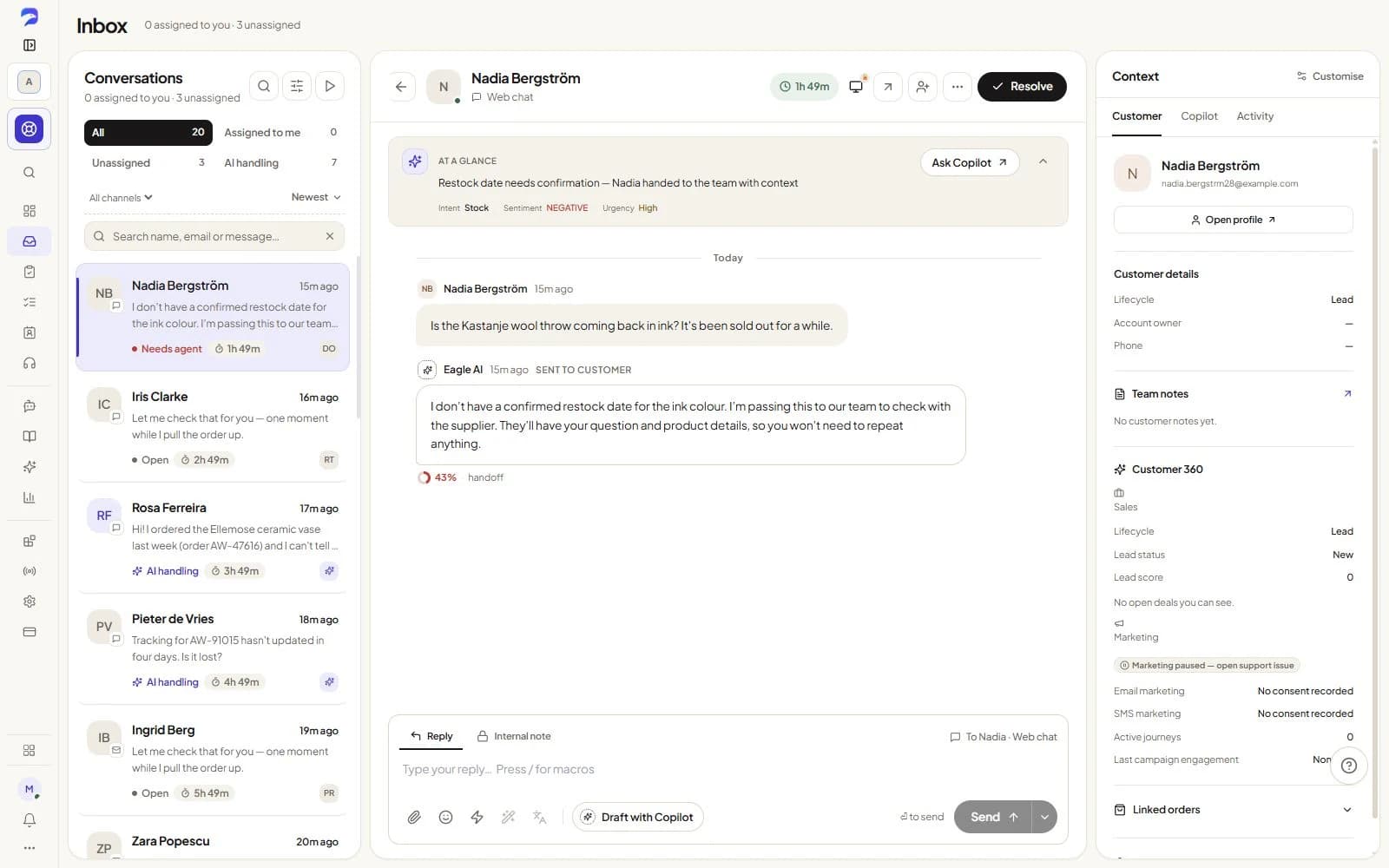
The support inbox in CustomerEagle with conversations from chat, email and social channels.
Real product views · sample data

Choose us over these three when

  • You want the AI allowance included in the seat price at a published overage rate — not Fin's $0.99 per outcome on top, not a Zendesk credit whose price isn't public, not a 500-session pack that doesn't grow with your team.
  • You need EU-based primary hosting on the plan you're already on — ours is, on every plan including Free, with AI provider locations and safeguards disclosed in our DPA. No Advanced/Expert upgrade, no sales call.
  • Money-moving actions must wait for a person: our AI never executes a refund or order edit alone, on any plan, with nothing to configure.
  • You want every AI answer cited to the document it came from, visibly, on every plan.
  • You'd rather be live today with one script tag than plan a multi-week implementation.

Choose one of them over us when

  • Budget is the only deciding factor: Freshdesk's Growth tier at $19 per agent per month undercuts our entry paid seat, and we're not going to pretend otherwise.
  • Your procurement checklist names SOC 2 Type II, ISO 27001/27018/27701 or FedRAMP LI-SaaS. Zendesk's certification stack is more extensive than ours, and that is a genuine reason to prefer it.
  • You need a large pre-built integration marketplace: Intercom states 350+ integrations out of the box including Slack, Jira and Salesforce, which is broader than our current integration set.
  • You need a phone channel that is past beta. CustomerEagle AI Voice is a self-serve beta add-on with a 14-day trial and requires setup; compare each provider's activation and plan terms before choosing.
  • You need automated ticket or conversation-history import. None of the three routes into us carries history — articles, contacts and companies move, tickets don't.
Sales

Turn a good conversation into a next step.

Bring leads, deals and follow-ups onto the customer record your team already knows. See what needs attention today and keep opportunities moving.

  • Lead inbox, deal pipelines and activity timelines
  • Meetings, sequences, sales goals and forecasts
  • AI follow-up drafts and shared customer context

Core Sales on every plan. Advanced tools on Professional; quotes and CRM sync on Premium. AI uses credits.

Explore Sales →
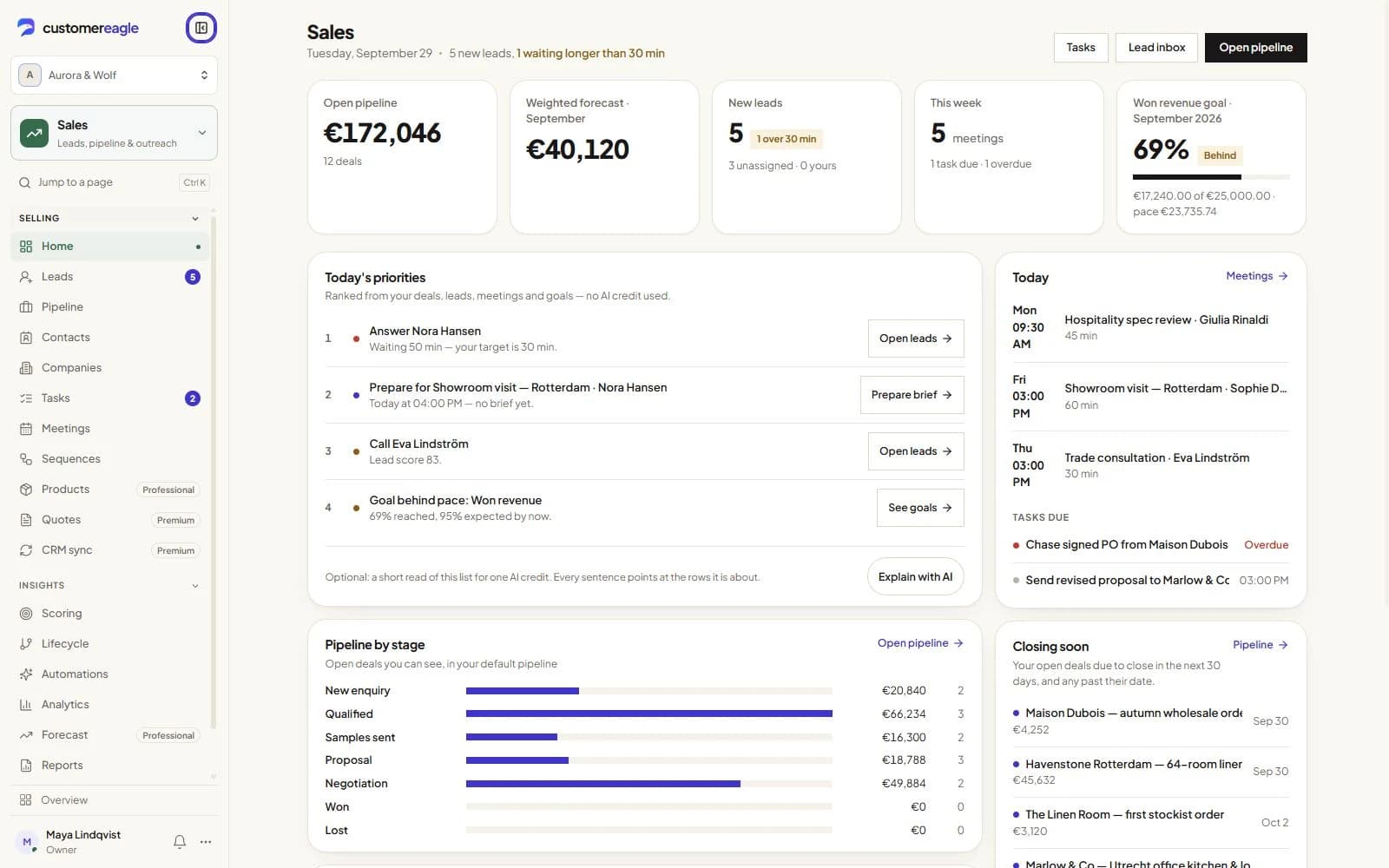
The Sales home: open pipeline, weighted forecast, new leads and today's meetings.
Real product views · sample data
Marketing

Stay relevant after the first conversation.

Build audiences from customer context, create campaigns and guide people through visual journeys. Keep consent and support context close to every send.

  • Email and SMS campaigns, forms and pop-ups
  • Audience segments and visual customer journeys
  • AI email drafts, campaign reports and consent controls

Separate paid add-on; features vary by tier. AI needs Standard or above and credits. SMS uses your provider.

Explore Marketing →
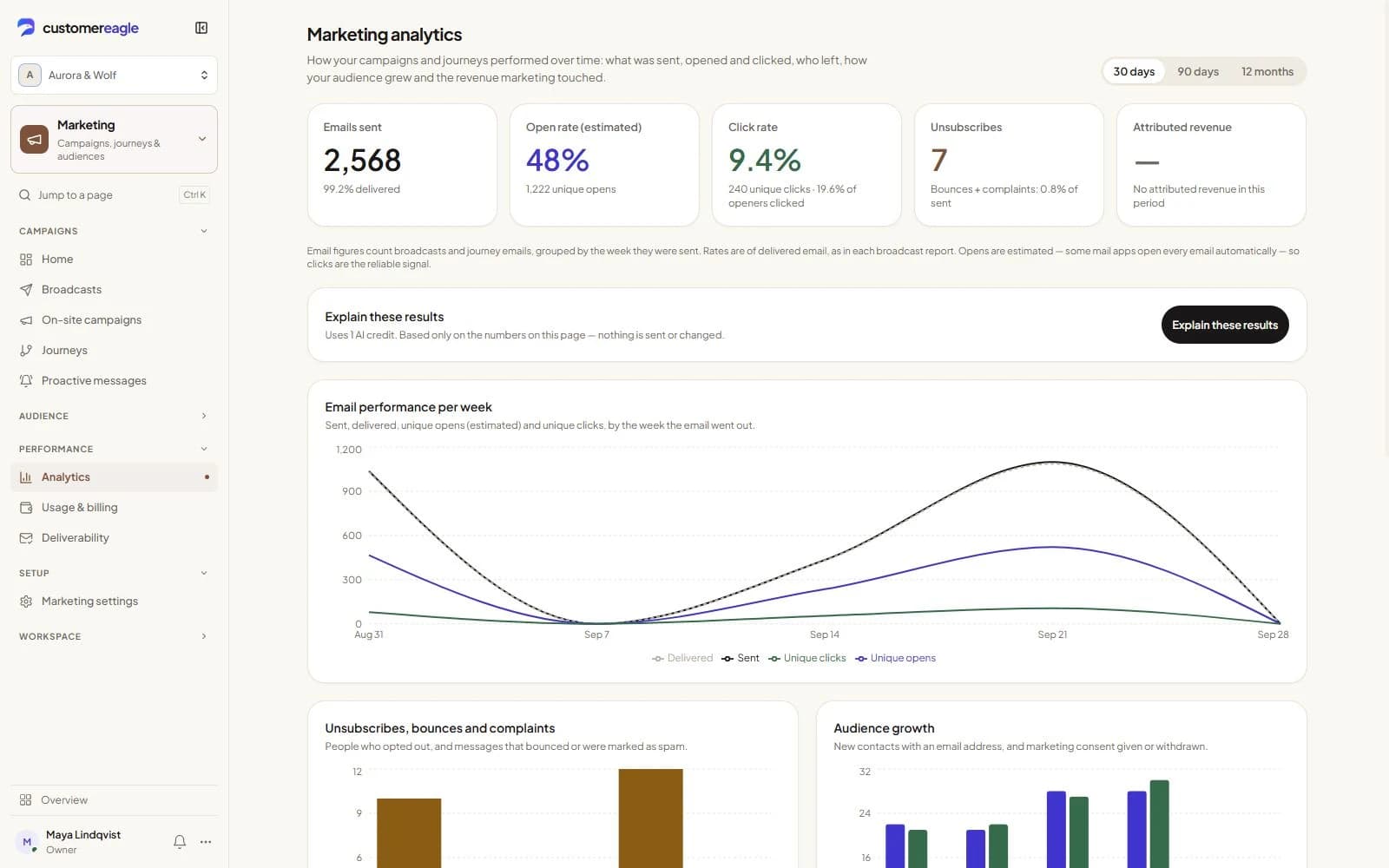
Marketing analytics showing email performance, engagement and audience growth
Real product views · sample data
FAQ

Frequently asked questions

Functionally, for most SMB and mid-market teams, yes: Intercom covers the shared inbox, help centre, routing and AI agent a Zendesk Suite plan does day to day. It stops being a replacement at the enterprise edges — Zendesk holds SOC 2 Type II, ISO 27001:2022, ISO 27018:2019, ISO 27701:2019 and FedRAMP LI-SaaS with EU Binding Corporate Rules approval since 2017, plus sandboxing, custom roles and approval workflows at Suite Enterprise scale. On price you swap a known AI fee for an unknown one: Intercom bills Fin at $0.99 per outcome on top of the seat, while Zendesk's per-credit rate isn't published anywhere on its own site.

Three that decide most evaluations. Billing: Intercom charges $0.99 per Fin outcome on top of published monthly full-seat prices ($39/$99/$139), while Zendesk publishes seat prices (€19 Support Team, €55 Suite Team, €115 Suite Professional, annual, EU storefront) but not its AI credit rate. Citations: Intercom's own help articles state Fin links its sources with every answer; Zendesk's AI Agents page doesn't state whether the customer sees a citation. Scale: Zendesk's certification stack and enterprise tooling go deeper, at the cost of implementations reportedly running from a few weeks to a couple of months, with third-party project costs cited from roughly $5,000 to $50,000+.

On list seat price alone, Freshdesk Growth is $19 per agent per month billed annually (€17 on the EUR storefront), against Zendesk's €19 Support Team and Intercom's $39 Essential on monthly billing. The three bill in different currencies on different bases, so we don't convert or declare an overall winner. The AI line matters too: Freshdesk includes 500 Freddy sessions once per account then charges $49 per 100, Intercom charges $0.99 per outcome, and Zendesk publishes no per-credit rate.

All three, and the units aren't equivalent. Intercom bills an outcome at $0.99 — a resolution, a procedure handoff, or a disqualification — once per conversation regardless of message count, confirmed on fin.ai/pricing. Zendesk bills outcome-based credits with a per-plan allowance and purchasable extras, but doesn't publish the per-credit price. Freshdesk bills sessions: for email, a 72-hour window from the customer's first message with all replies inside counted as one, the first 500 included once per account, then $49 per 100. Note that two of Intercom's three billable outcomes — a handoff and a disqualification — aren't resolutions in any ordinary sense.

Freshdesk, on the evidence we could find: you choose a hosting region including the EU at account signup, on every plan including Free — though the exact EU country isn't specified on the pages we checked, and Freshdesk's own GDPR page still references the invalidated EU-US Privacy Shield as a transfer mechanism. Intercom's Regional Data Hosting does confirm an EU region (Dublin) with EU backups, but it's Advanced/Expert only, provisioned by Intercom Sales rather than self-serve, and excluded from the Early Stage program. Zendesk's Data Center Location add-on covers the EEA, and third-party sources describe it as available from Suite Professional and up.

Two ways in

Price your AI before you buy it, not after

Try Professional free for 30 days, with Support and Sales in one workspace. Add Marketing when you’re ready.